The city of Plymouth is home not only to Parks’ Place but also to Jodi Melsness, registered nurse who works with people with dementia and live in memory care. On top of that, her own mother was diagnosed with dementia and Jodi became her caregiver. Jodi started a blog to share her journey as a caregiver of someone with dementia, and ultimately turned her blog into a memoir, The Lemon Bar Queen.
Her memoir describes the journey as a caregiver, capturing fun moments, happy moments, difficult moments, and low moments. Caregivers at any stage of their caregiving journey will be able to relate to Jodi and her journey.
It was because of Jodi’s relatability and local connection that we reached out to her to see if she would be willing to speak about her book with family caregivers. At Parks’ Place, we understand that the diagnosis of dementia affects the whole family in addition to the person with dementia. Caregivers now find themselves in a role they never expected with new challenges every day. Caregivers being able to connect and relate to each other helps to lessen the sense of isolation, which can happen as the dementia in their loved one progresses. We saw Jodi’s experience and expertise as a great opportunity to host an event geared towards caregivers connecting and relating to one another. Jodi was immediately interested and jumped at the chance to meet with us!
We had a group of about 12 family caregivers on zoom with Jodi as she described her journey and the perspective she brought as a registered nurse. The time flew by in what felt like just a few minutes, and before we knew it, 90 minutes had passed! The 90 minutes was full of sharing stories, perspective, questions, and a little behind the scenes of what it’s like to write a book.
We enjoyed our conversation with Jodi so much, we invited her to be the keynote speaker for the Inaugural Parks’ Place Family Symposium taking place later this month. The Family Symposium is an event for our current residents’ family members and will have various speakers from our leadership team and the Parks family. Jodi will be our keynote at the end of the event. We are so excited to be working with her again.
If you’d like to learn more about Jodi and The Lemon Bar Queen, you can find her here at her website.
Parks’ Place Memory Care is a privately owned assisted living home, specialized and specifically designed for those with Alzheimer’s and other dementias. Our home is for people of any stage of dementia so they are able to age-in-place in their home. For tours, general information, or admission inquiry, please contact Kaitlin Kelly at 763-710-8484.
Disclaimer: The following information is neither legal advice nor making specific recommendations for your loved one’s financial situation. It is purely informative. Please consult an elder law attorney to aid you in managing your loved one’s finances.
Planning Ahead
Navigating the path of financial and legal decision making is hard. Not only is it difficult to learn the legal terms, documents, and what they do, but emotionally it is difficult to think about you or your loved one’s possible incapacity, declining health, and ultimate death. Planning ahead can lessen the burden and emotional strain on loved ones if you are able to take the time and energy needed to plan ahead. But where to start?
You can start informally with a discussion. If you are going to start to assist or take over finances, you will need to learn about their assets, income, property, bills, debts, liabilities, bank information, etc. You will also want to discuss the types of insurance they have, what is covered, and the benefits. You will want to make a list or spreadsheet of contacts and phone numbers of banks, insurance companies, physicians, and any financial manager/consultant.
Formally, you may want to hire an elder law attorney. Your elder law attorney can help you with executing a power of attorney, preparing a will, and creating a health care directive. If you are also planning ahead for an assistance program such as Medical Assistance and Elderly Waiver, your elder law attorney can help you with the application process.
Here are some factors you may want to consider while planning ahead for the future.
Financial Status
Overall, what is their financial status? You will want to inquire if they have a home, car, CDs, stocks, annuities, or an IRA. Are the accounts titled in their name alone or is it a joint tenancy or “authorized signature” account? Do they have a monthly income? Look into a pension, social security, veteran’s benefits, or annuity payments. Make sure all beneficiary designations are up to date.
Insurance
Does your loved one have insurance? If so, what type? Compile the names, phone numbers, and policy numbers of the insurance carriers. Find out the types of services that are covered under their insurance policies. Most health insurance does not cover long-term or skilled nursing care so finding out if they have long-term care insurance will be very important; also what the benefits are and for how long.
Health Care Directive
In the state of Minnesota, the Minnesota Health Care Directive allows for someone to appoint a “health care agent” to make their health care decisions if they are no longer able. Multiple people can be appointed as a health care agent in the Health Care Directive, not just one. In the Health Care Directive, the person can state their wishes for the types of medical treatment they do or do not want. This is their opportunity to voice their concerns with the health care agents. An attorney is not required to complete the Health Care Directive; most hospitals and physician offices can provide one to be filled in. It will require the signature of two witnesses or a notary public.
Estate Planning
Estate Planning is best to be discussed with an attorney as there are many topics involved. We will go over a few of them now.
Power of Attorney
The Power of Attorney allows someone to appoint another person to act on their financial behalf. There are two common documents in Minnesota, the Minnesota Statuary Short Form Power of Attorney and the Common Law Power of Attorney. The Minnesota Statutory Short Form Power of Attorney provides multiple options and someone can select to shift power to someone else. The Common Law Power of Attorney will cover specified powers or provisions that are not included in the short form. This is drafted by an attorney.
Last Will and Testament
A will is a legal document that assures the person’s assets are distributed to the wishes of the individual after their death. This is a legal document to help ease the transition of the ownership of an estate after death. This will not go into effect until after death and does not guarantee avoiding probate.
Trusts
This is a legal arrangement where an individual (the beneficiary) allows for a person or financial institution (the trustee) to hold legal title to and manage the assets for the benefit of the beneficiary. The person who creates and funds the trust is the grantor. A “living trust” or “inter vivos trust” is used as a tool to plan for incapacity as it is created by a trust agreement during the grantor’s lifetime. This individual transfers ownership and control of their assets to the trust while still living and the property transferred is used for the grantor’s benefit during his or her life. When the grantor can no longer serve as trustee due to incapacity, the successor trustee named in the trust agreement will take over as the trustee.
Guardianship and Conservatorship
These are forms of substitute decision making established through a legal action or proceeding. In the legal proceeding, the court will order the appointment of a person as guardian or conservator to act as the substitute decision maker for another person, the ward or protected person. Most often, the guardian is appointed to make decisions regarding the person’s personal care such as deciding on appropriate residence, medical provider, or medications. The conservator will make decisions involving the financial care, this included property management, investment of assets, and bill paying.
Parks’ Place Memory Care is a privately owned assisted living home, specialized and specifically designed for those with Alzheimer’s and other dementias. Our home is for people of any stage of dementia so they are able to age-in-place in their home. For tours, general information, or admission inquiry, please contact Kaitlin Kelly at 763-710-8484.
Being a caregiver for a person with dementia is a more than a full time job, its 7 days a week, 365 days a year, and often 24 hours a day. Your duties as a caregiver are constant throughout the day from daily hygiene, meal and medication preparation, transportation, and managing the medical appointments of the person with dementia. Often, you have no time or energy left for yourself.
So who is taking care of you? To be able to pour from your cup, you must first fill your cup. Neglecting your own needs can affect your health and wellbeing, and therefore affect your ability to care for your loved one with dementia.
The Minnesota Senior Linkage Line offers the following Caregiver’s Bill of Rights
Take care of myself. This is not an act of selfishness. It will give me the capability of taking better care of another.
Seek help from others, even if the person I care for objects. I recognize the limits of my own endurance and strength.
Maintain facets of my own life that do not include the person I care for, just as I would if they were healthy. I try to do everything that I reasonably can for this person, and I have the right to do some things just for myself.
Get angry, be depressed, and express other difficult feelings occasionally.
Reject any attempts by the person I care for (either conscious or unconscious) to manipulate me through guilt and/or depression.
Receive consideration, affection, forgiveness, and acceptance for what I do from my family, for as long as I offer these qualities in return.
Take pride in what I am accomplishing and to applaud the courage it has sometimes taken to meet the needs of the person I care for.
Protect my individuality and my right to make a life for myself that will sustain me in the time when the person I care for no longer needs my full-time help.
Expect and demand that as new strides are made in finding resources to aid physically and mentally impaired persons in our country, similar strides will be made towards aiding and supporting family caregivers.
Source: Minnesota Senior Linkage Line
Your Network of Support
Caring for someone with dementia can often feel lonely and draining. You may have feelings of anger, fear, sadness, fatigue, and love all at the same time. Building a support network for yourself is a safe place to share your feelings, lean on others, and walk alongside others who are on the same journey as your. Most communities have a variety of support groups. You can check out the Alzheimer’s Association, the Minnesota-North Dakota Chapter of the Alzheimer’s Association, local churches, or the social service department of a local hospital. Also, word-of-mouth is a great way to find a support group as well.
Asking for Help
Asking for help is difficult, but important. Being human means that we all have limits on what we can do. Asking for help when you are reaching your limits is the best way to continue caring for your loved one. The Family Caregiver Alliance has an excellent Self-Care guide for Family Caregivers. Additional resources are listed below:
Parks’ Place Memory Care is a privately owned assisted living home, specialized and specifically designed for those with Alzheimer’s and other dementias. Our home is for people of any stage of dementia so they are able to age-in-place in their home. For tours, general information, or admission inquiry, please contact Kaitlin Kelly at 763-710-8484.
Monday, the 18th, there was an electric feeling in the air at Parks’ Place – we hosted a vaccine clinic for our residents, staff, and essential caregivers to receive the first dose of the Pfizer vaccine!
We turned our clinic into a party to celebrate this first step in protecting our residents and the first step towards normalcy. Our party was complete with balloons, cookies, streamers, and a photo station! As the essential caregivers began to arrive, we could feel the sense of community and comradery among the residents’ families. We started to feel like our “old selves” before COVID, and the family-filled home we always intended to be.
We aren’t through with COVID quite yet, but the vaccine clinic brought the first ray of hope of a post-COVID world.
Parks’ Place Memory Care is a privately owned assisted living home, specialized and specifically designed for those with Alzheimer’s and other dementias. Our home is for people of any stage of dementia so residents are able to age-in-place in their home. For tours, general information, or admission inquiry, please contact Kaitlin Kelly at 763-710-8484.
As it becomes apparent that your loved one needs extra support in his or her daily life, it can be difficult to know the necessary type of support. There is a large continuum of care available to elders with many more options than 50 years ago. So, how do you know what type of care fits your loved ones needs? How can the care adapt as your loved one’s needs change?
First, let’s take a look at two models used to inform care and when a move or transition is needed: the Person-Environment Fit Model (P-E Fit) and Transitions Theory. These are models used in the gerontological field to help determine care settings.
Person-Environment Fit Model (P-E Fit)
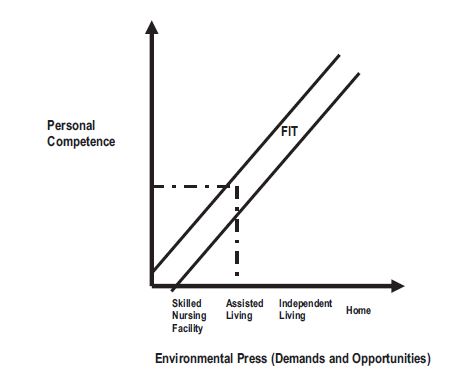
The P-E Fit Model provides insight into the person and environmental factors that influence health outcomes, in other words, it is focused on the relationship between the person and the environment he or she is living in. Below is a graphic description of this model. The y-axis is personal competence; this is the health, cognition, motor skills, and sensory perception of the individual; in other words, their physical and cognitive abilities. The x-axis is the environmental press, meaning the demands the environment places upon the person living there. Think of the demands of the environment as the tasks that need to be completed to live in that environment, such as household chores, home maintenance, shopping, cleaning, etc. and the personal tasks like managing medications, eating, toileting, grooming, bathing, dressing, etc. Basically, the higher the environmental press, the higher the personal competence needed to live in that environment.
The area where personal competence and environmental press meet is depicted as a band. If the elder falls within this band, he or she would be “in fit”, meaning his or her abilities align with the demands of the environment. If the elder does not fall within the band, he or she would be “out of fit”, meaning their personal abilities do not align with the demands of their environment. If someone is out of fit, they cannot safely live in that environment and two things can happen: the environment can be adapted or there can be changes to the personal competence through another person supporting him or her.
How does the environment adapt? It can adapt in multiple ways. The place of living can be simplified physically by eliminating trip hazards, putting everything needed on one level, eliminating clutter or too many items, etc. Or, the environment can be changed by moving to an assisted living, memory care, skilled nursing facility, etc. based on the needs of that individual. By changing the environment to a level that matches the personal competence, the person can thrive in fit.
How can personal competence adapt? To expect that a person with dementia will adapt to meet the demands of environmental press is unrealistic. But, that does not mean that someone else cannot bridge that gap. If the person with dementia is living at home or in independent living, a family member or hired in-home care could provide the competence needed. If the person with dementia is in assisted living, the care staff may bridge the gap. But, there will come a time when the needs of the person with dementia will outgrow what the assisted living can provide.
Transitions Theory
In Transitions Theory, a transition occurs when the individual’s established behavior patterns are no longer adequate for the demands of the situation and the assumptions about oneself or the world are challenged. The transition is subjective to each individual to the recognition of change, meaning a transition happens when the person can perceive there is a change happening. Commonly occurring transitions later in life include relocation, changes in health or function, loss of relationships, and role changes. A transition can trigger another transition, for example, loss of function can trigger a need for relocation, which can cause disorientation.
Memory Care or Assisted Living?
Now let us circle back to making a decision between a memory care or an assisted living. Using what we know about P-E Fit and Transitions Theory can help us make a decision. No one is a fortuneteller who can predict the future, but you are able to make educated choices to help reduce rocky changes.
It is important to understand the services available in each setting, how the services can grow with the resident, and any limitations in services. Let’s take a look at the average assisted living and the average memory care home in the chart below, please note this is not an exhaustive list.
Assisted Living
Memory care
Available Services
Environmental support (i.e. Housekeeping and laundry). Assistance with ADLs. Simple physical environment. Signage for cuing. Visible staff. Structured social activities. Health monitoring.
Environmental support (i.e. Housekeeping and laundry). Assistance with ADLs. Simple physical environment. Signage for cuing. Visible staff. Structured social activities. Health monitoring. Managing symptoms of dementia. Specialized activities for people with dementia. Dementia specific staff training. Secured entry.
Limitations
Managing symptoms of dementia past early stage. Specialized activities for people with dementia. Health condition that requires 24 hour monitoring by a nurse. Managing behavioral symptoms.
Health condition that requires 24 hour monitoring by a nurse. Unsafe behavioral symptoms by residents.
How do you know what is right for you? We are not able to answer that for you, but you can apply this information to the unique situation of your loved one and his or her needs. You can assess the needs, personal competence, environmental press, and transitions and make an informed decision for or with your loved one.
What Can Parks’ Place Memory Care Provide?
Park’s Place provides all the items listed under the average memory care and much, much more. So what sets us apart? Using both P-E Fit Model and Transitions Theory, three major ways to assist residents are to improve personal competence, bolster the environment, support transitions, or a combination of all three. Which is exactly what we do.
Improve Personal Competence. As stated earlier in this blog, it is an unrealistic expectation that someone living with dementia will be able to improve his or her personal competence. If you are searching for a memory care for your loved one, he or she passed the point of being able to adapt their personal competence. But, our staff is able to bridge the gap so their personal competence meets the environmental press. For example, we provide assistance for any and all cares from a simple verbal cue to full hands-on assist. We are able to meet the needs of the resident wherever he or she is in their dementia journey and expand cares as time goes on.
Additionally, our specialized activity program is designed to be a form of treatment for dementia, not just something for the residents to pass the time. The activity program helps to orient the residents to the time of day and works within their abilities so that they feel a sense of purpose and productivity. Because the activity program works within the ability of the residents, it matches their personal competence. We will also look at activities while discussing transitions.
Bolster the Environment. Our home was designed for the person living with dementia. It is single level with a simple, flowing footprint to allow for residents to safely walk or wander without getting lost. We are barrier free so residents do not feel a sense of confinement. Our main area has all the elements of a regular home, including a kitchen, living room, TV room, and a sunroom. It is designed to make you feel at home and not in an institution. This helps to reduce the feeling of living in a facility to just moving to a new home, therefore reducing the sense of change for the resident. Additionally, the overall design and services we provide reduce environmental press for the resident and allows residents to live in fit.
Support Transitions. As we learned, transitions are not only environmental transitions like moving to a new home, but also cognitive, physical, and emotional. The environmental transition of moving to a new home will vary from person to person, for some it may be a big change, for others not so much. Our home is for people of all stages of dementia so they will only need to move once, and experience that transition once, during their dementia journey. Cognitively, as people transition from one stage to the next, we are able to meet them where they are and adjust the cares, communication, and activities as necessary. Physically, people with dementia will need more assistance as they progress. They may go from walking and transferring unassisted to needing a one-person assist, to a two-person assist, to needing a mechanical lift. Changes in physical ability will also affect other areas such as lifting their arms to wash their body in the shower to lifting eating utensils. We are able to support our residents during each one of these transitions by increasing the hands-on level of care. Emotionally, as people age they will begin to lose relationships and friends as the resident is no longer able to recognize friends and family members or those close to them pass away. Our staff provides emotional support in a variety of ways, by gently reminding residents who their visitors are, providing friendship, and by being a kind, trusted person to provide cares. We also can design activities or have activities available for residents that are reminiscent or purposeful for them. These types of activities help to smooth transitions by reducing the perception of a change for the person with dementia.
To learn more about Parks’ Place and how we can support your loved one, call Kaitlin at 612-358-3725 or email her at Kaitlin.kelly@parksplacememorycare.com.
The source used for this blog post can be found here.
Parks’ Place Memory Care is a privately owned assisted living home, specialized and specifically designed for those with Alzheimer’s and other dementias. Our home is for people of any stage of dementia so they are able to age-in-place in their home. For tours, general information, or admission inquiry, please contact Kaitlin Kelly at 612-358-3725.
The timing of finding a home is unique for each individual with dementia. Just as no two people will have the same journey with dementia, no two people will have the same timeline and circumstances that will contribute to finding a home. This makes it very difficult for families to know when the time is right to make the move to an assisted living or memory care home.
We All Have Limits
It is important for caregivers to understand and acknowledge his or her own limits. As human beings, we all have limits: physically, emotionally, stress tolerance, spiritually, etc. It is important caregivers recognize what his or her individual limits are. In recognizing their own limits, caregivers will know when the care needs of their loved one has reached or surpassed what the caregiver is able to provide. There is absolutely no shame in recognizing your limits and no reward for pushing yourself past those limits. Pushing past those limits can lead to caregiver exhaustion and inadequate care for the person with dementia.
Caregivers who are spouses to someone with dementia often feel like they are not living up to their marriage vows of sticking with their spouse “in sickness and in health.” But, in fact, they ARE living up to that vow. They are finding the help they need to keep their vow of loving and caring for their spouse through their sickness.
Financial Analysis
It is equally as important to evaluate your loved one’s finances. Knowing the finances your loved one has available will help you determine the care setting (in-home or at a memory care) and the duration of time your loved one can pay privately. If your loved one will be using Medical Assistance (MA), it is important to know the duration of private pay he or she has prior to going on the program. Or, if their only funding is MA, that will limit their options as not all homes will accept MA without an initial private pay period.
Gradual Changes vs. an Event
There are two fairly common patterns for people moving into a memory care, either a gradual change over time with increasing needs above what the caregiver can handle or an event happens that illustrates the safety risk of that person living in his or her current setting.
If family members are noticing changes and they start to search for a home, it generally is less stressful. It is less stressful because there isn’t an emergency that is prompting this seach. They can take their time to tour and compare the different homes in their area. They also have more control over the timeline of the move.
If there has been an event, generally families must find a home under emergent circumstances. They tend to need placement in a week or less, which adds to the stress of the move. The types of events which may prompt an emergency move scenario can arise from a wide range of situations. Sometimes, the person with dementia is very good at hiding their deficits so family members are unaware that the person with dementia is in an unsafe living situation until the event happens. The other common event is a hospitalization due to the person’s deficits (example: mismanaging their medications) and the doctor recommends this person discharges to a memory care. Caregivers often find themselves needing to find placement on a week’s notice or are subject to the hospital’s discharge date as a deadline to place their loved one.
Our Advice
Our advice is to do your research early. Even if you do not think your loved one will need placement for a year or more, start researching what is available in your area. Find 3 or 4 homes that you are comfortable with your loved one possibly living and ask to be on their waitlist. They will check in with you every 3-6 months (or so) to see if there have been any changes and if you’re thinking a move is coming. This will also prepare you in case your loved one has an event that prompts a quick move. If this happens, you already know what your options are and where you’d like your loved one to live.
If you are interested in learning more about Parks’ Place, call Kaitlin at 612-358-3725 or visit our website at www.parksplacememorycare.com.
Parks’ Place Memory Care is a privately owned assisted living home, specialized and specifically designed for those with Alzheimer’s and other dementias. Our home is for people of any stage of dementia so they are able to age-in-place in their home. For tours, general information, or admission inquiry, please contact Kaitlin Kelly at 612-358-3725.
Early diagnosis of dementia is crucial to preventing a crisis and for planning treatment and care. It is difficult to tell if cognition changes are simply age related changes (normal aging) or dementia (not normal aging).
Therefore, knowing when to seek in-home care or place a loved one in a senior living home is very difficult to judge. This is especially true for individuals without a serious medical condition outside of their cognitive changes.
What is the difference between simple forgetfulness and a serious memory loss?
Here are some warning signs of memory loss that may signal the need for assistance care. They were gathered from a variety of sources:
Does he/she repeat questions more frequently?
Yes
No
Does he/she exhibit poor grooming and personal hygiene
Yes
No
Does he/she forget to take medications or take them incorrectly?
Yes
No
Has there been a change in eating habits or loss of appetite?
Yes
No
Is outdated food in the refrigerator or little nutritious food?
Yes
No
Has driving been impaired? Frequent accidents?
Yes
No
Is he/she increasingly forgetful?
Yes
No
Is he/she moody or depressed?
Yes
No
Has there been a loss of interest in socializing?
Yes
No
Is he/she less interested in former activities?
Yes
No
Is he/she unsteady on her feet or does she fall frequently?
Yes
No
Does he/she have difficulty concentrating?
Yes
No
Does he/she exhibit poor judgment?
Yes
No
Is he/she incontinent?
Yes
No
Is there trouble handling finances? Are there unpaid bills?
Yes
No
Does he/she spend long periods of time doing nothing?
Yes
No
Have others noticed personality changes?
Yes
No
Is there unopened mail lying around?
Yes
No
Is there poor housekeeping or unsafe conditions?
Yes
No
Does he/she have trouble making decisions?
Yes
No
Does he/she get lost?
Yes
No
Does he/she have trouble finding the right words?
Yes
No
Does he/she wear the same clothes over and over again?
Yes
No
This is also available here has a printable worksheet to fill out and bring to your next appointment with your physician.
See your physician for further evaluation if you have answered “yes” to a majority of these questions. Then call us to learn more about our home and how we can serve your loved one on his or her dementia journey.
Parks’ Place Memory Care is a privately owned assisted living home, specialized and specifically designed for those with Alzheimer’s and other dementias. Our home is for people of any stage of dementia so they are able to age-in-place in their home. For tours, general information, or admission inquiry, please contact Kaitlin Kelly at 612-358-3725.
Karen and Jerry Parks joined a brand new chorus group 6 years ago, not knowing that in a few short years it would inspire chorus groups across the country and the world.
Inaugural Members
In 2014 the Giving Voice Chorus was created when two faculty members who had cared for a loved one with dementia were impressed by the research about the powerful effects of music on the lives of people with dementia. The chorus started with just 30 inaugural members from across the metro area, but word spread quickly throughout the dementia community about the fantastic new chorus group and it rapidly expanded to three choruses, totaling just under 200 members.
A fourth chorus group has been added for fall of 2020 to accommodate the growing interest. If you are interested in joining, click here to go to the registration webpage. Additionally, Giving Voices assists the Amazing Grace chorus in St. Paul, an African-American chorus group.
Finding Camaraderie and Purpose
Chorus members will tell you that rehearsal day is their favorite day of the week. The motto of the group is “there is no wrong in this room” meaning, there is no stigma, no judgement, no negativity—only acceptance, friendship, and support. Worrying about judgment and insensitivity from others when out in the community washes away when members arrive for rehearsal. For many of them, chorus practice is the only time they can be themselves. The joy, comradery, sense of purpose, and acceptance the chorus members feel at rehearsal led to the rapid expansion in the metro area and has led to the creation of chorus groups across the country and the world.
Inspiring Chorus Groups across the Country and around the World
Word of Giving Voice spread far beyond the metro area. Chorus groups have sprung up throughout Minnesota and 16 other states. Worldwide, you will find chorus groups in Australia, Canada, and the United Kingdom, all inspired by Giving Voice. If you are interested in creating a group in your area, click here.
Love Never Forgets
The chorus received a grant through Healing & Hope Through Song, an American Composers Forum for a lyricist and a composer to write original songs about the experiences of the members of the chorus. The song topics ranged from slowly losing a loved one over time, living in the moment, and looking forward to the cookies after rehearsal. The composers were originally supposed to create two songs, but they ended up writing nine original songs.
The chorus began conversations with The Ordway about performing their original songs. The performance quickly sold out all 2206 seats! This performance was evidence that people with dementia can learn new things. The performance was truly incredible, the lyrics bringing the audience and singers alike to tears. It was a major accomplishment for the chorus members living with dementia to learn and perform new songs. The excitement and sense of accomplishment was tangible as the performance came to a close. Twin Cities PBS created a segment about the performance (which won them an Emmy!), the segment can be viewed here.
Giving Voice at Grand Opening
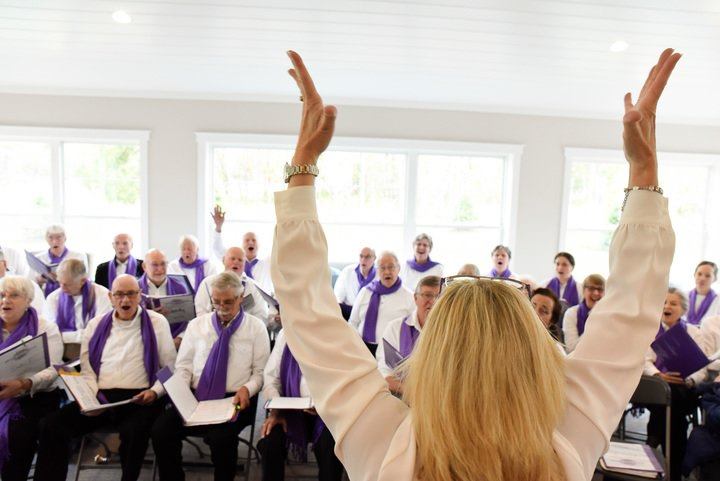
As part of our Grand Opening the Giving Voice Chorus graced us with their presence as they filled our home with joyous singing. Approximately 30 members of the chorus joined us in our sunroom and sang out into our great room filled with guests to celebrate our opening!
Karen Parks kicking off the performance with Giving Voice at Grand Opening October 13, 2019.
The Pandemic Pivot
Due to coronavirus, the chorus was not able to rehearse in person. They quickly pivoted to virtual rehearsals to keep their members engaged and connected. To see the video they created for the end of the summer session, titled You = Joy & Belonging, click here.
Parks’ Place Memory Care is a privately owned assisted living home, specialized and specifically designed for those with Alzheimer’s and other dementias. Our home is for people of any stage of dementia so they are able to age-in-place in their home. For tours, general information, or admission inquiry, please contact Kaitlin Kelly at 612-358-3725.
Dementia can be a difficult disease to diagnose because there is no single definitive test to identify it or which type. Most physicians agree, however, that improving early diagnosis of dementia is important for patients and their families, as well as for researchers looking for ways to halt or slow the progression of the disease. Early diagnosis also can reduce the risk of inappropriate treatment.
Today, many physicians and researchers are enthusiastic about using levels of beta amyloid and tau in spinal fluid to diagnose Alzheimer’s disease. If studies confirm the validity of this approach, it may allow physicians to identify people who are beginning to develop the disease before they experience symptoms.
About Dementia Diagnosis
While each physician will diagnose the disease in his or her own way, the following are common elements of most diagnostic procedures.
Patient history and physical exam. The first step for most physicians is to conduct a patient history, including overall medical and emotional health, plus a comprehensive physical examination. These tests will rule out any underlying disorders that might contribute to dementia, such as depression, normal pressure hydrocephalus, or vitamin B12 deficiency.
Neurological evaluations. Physicians will usually perform a neurological examination, checking balance, sensory function, and reflexes to identify conditions that may be treatable, such as movement disorders or stroke.
Cognitive and neuropsychological tests. There are numerous tests that measure memory, language skills, and other abilities related to cognitive functioning. These may include the Mini-Mental State Examination (MMSE) to assess cognitive skills in people with suspected dementia. This test measures a person’s orientation, memory, and attention.
Brain scans. Physicians also may use a variety of brain scans, such as computerized tomographic (CT) scans and magnetic resonance imaging (MRI) to identify strokes, tumors, or other problems that can cause dementia. Scans can also spot cortical atrophy, or degeneration of the brain’s outer layer, as well as changes in the brain’s structure and function that might suggest Alzheimer’s disease. Additionally, they can show evidence of changes to the blood vessels and other problems such as hydrocephalus and subdural hematomas. Another brain scan, the electroencephalogram (EEG) detects and records patterns of electrical activity in the brain, enabling physicians to see abnormalities which might indicate cognitive dysfunction.
Several other types of functional brain scans are currently used in research and may ultimately lead to earlier diagnosis of dementia:
Functional MRI (fMRI) measures metabolic changes in the brain by using radio waves and a strong magnetic field.
Single photon-emission computed tomography (SPECT) shows the distribution of blood in the brain.
Positron emission tomography (PET) scans detect changes in glucose metabolism, oxygen metabolism, and blood flow.
Magnetoencephalography (MEG) shows the electromagnetic fields produced by activity of the brain’s neurons.
Laboratory tests. Laboratory tests help diagnose dementia, as well as rule out other conditions, such as kidney failure, that can contribute to symptoms. Typical lab tests include a complete blood count, blood glucose test, urinalysis, drug and alcohol tests (toxicology screen), cerebrospinal fluid analysis (to rule out infections that can affect the brain), and analysis of thyroid and thyroid-stimulating hormone levels.
Psychiatric evaluation. Sometimes physicians will suggest a psychiatric evaluation to determine if depression or another psychiatric disorder is causing symptoms of dementia.
Dementia Treatment
Exciting research continues to accelerate as scientists learn more about the causes of dementia. Many treatments are available, while new treatments are under consideration or in development.
Alzheimer’s Disease: Some Alzheimer’s patients benefit from a category of drugs called cholinesterase inhibitors that improve symptoms and slow the progression of the disease, improving the patient’s quality of life. They work by slowing the breakdown of the neurotransmitter acetylcholine, which helps to form memories and is used in the hippocampus and the cerebral cortex, two brain regions that are affected by Alzheimer’s disease. The cholinesterase inhibitors approved for use in the United States are: tacrine, donepezil, rivastigmine, and galantamine, among others.
Memantine regulates the activity of a neurotransmitter called glutamate that plays a role in learning and memory, and is often disrupted by Alzheimer’s disease. Physicians also sometimes prescribe anticonvulsants, antipsychotics, sedatives, and antidepressants to treat specific problems associated with dementia.
Vascular Dementia: Cholinesterase inhibitors, including galantamine, improve cognitive function and behavioral symptoms in some patients with early vascular dementia, but for most patients treatments are designed simply to reduce the risk factors for further brain damage. The progression of vascular dementia often can be slowed if underlying risk factors, such as high blood pressure, high cholesterol, heart disease, and diabetes are treated.
Other Dementias: Some studies have suggested that cholinesterase inhibitors, such as donepezil, can improve behavioral symptoms in some patients with Parkinson’s dementia. They also may be able to improve cognitive function in patients with Lewy body dementia. Currently, there are no medications approved specifically to treat or prevent most other types of progressive dementia, but sometimes physicians prescribe sedatives and antidepressants to treat specific parkinsonian and psychiatric symptoms.
Parks’ Place Memory Care is a privately owned assisted living home, specialized and specifically designed for those with Alzheimer’s and other dementias. Our home is for people of any stage of dementia so they are able to age-in-place in their home. For tours, general information, or admission inquiry, please contact Kaitlin Kelly at 612-358-3725.
When Jerry Parks was diagnosed at age 56 with young onset Alzheimer’s disease (AD) his family started to search for support groups. Moreover, not just a general group, but groups specific to their situations. His wife, Karen, searched for a support group for spouses of people diagnosed with young onset. His daughter, Katie, looked for a support group of others who were the children of a person with young onset. What they both found was there wasn’t a support group that fit their respective category. This dearth of support sparked them to create their own groups for others like them.
Karen’s Search
Karen wanted to connect with others who were facing the same challenges as her. Jerry’s diagnosis at age 56 was at a very different stage of life than someone diagnosed at age 86. Jerry was at the height of his career and they had children who were still in their teens; Karen desperately needed to connect with someone who was facing the same situation and feeling the same losses as her.
Karen reached out to the Alzheimer’s Association to connect with others who were the spouse of a person with young onset AD. Unfortunately, at that time the support group she was looking for did not exist. She told the Alzheimer’s Association to share her name and phone number to anyone else who inquired about a support group for spouses of young onset AD, but due to strict privacy policies, they were unable to do so.
It was not until Karen and Jerry were on a discussion panel with the Alzheimer’s Association that Karen found the connection she was looking for. As the members of the panel introduced themselves, three other couples sitting on the panel were also a husband and wife duo with the husband having a diagnosis of young onset AD. All four of the wives locked eyes and rendezvoused afterwards to connect. That night they went out to dinner, all eight of them, and decided they would go to dinner once per month from there on out. The four wives wanted to give themselves a name and they landed on “The Pisa Girls,” because they could lean on each other for support and they were a tower or strength for each other. Since they connected 13 years ago, they have only missed one dinner together.
Karen has found support in other ways, such as being a member of the Giving Voice Chorus. The chorus is comprised of people with dementia and their care partners. At choir practice, the motto is “there is no wrong in this room” which allows for the people with dementia to be at ease with each other. Karen found that just as Jerry found support and fellowship in the chorus group, so did she. She was able to connect with other caregivers and develop bonds of support and friendship with them.
Young Adult Child of a Person with Young Onset AD
Jerry’s daughter, Katie, was also looking for support. Similar to her mom, she wanted to connect with others who were facing the same situation she was at age 22. She went to a few sessions of a support group she had found, but there were not others like her in the group. It was mainly people who were much older than her, and were facing a much different set of circumstances. While it provided support, she was looking to connect with others more similar to her. Ultimately, she ended up creating a support group for young adult children of a parent with young onset Alzheimer’s disease (abbreviated YAC-P-YOAD).
Katie did not set out to create the group. The Alzheimer’s Association asked her to be on a panel to discuss needs of family members, how the Alzheimer’s Association could collaborate with them, and what events they wanted to do. The other panelists were also people impacted by young onset AD. All of the panelists told the Alzheimer’s Association that what they needed was support groups.
The Alzheimer’s Association did not create a support group, but rather trained Katie on how to lead a support group and then shared Katie’s information with others. It grew rapidly from four people at the first few meetings to over 40 in the first year of existence. The ages of those who attended ranged from 13 to late 30s. The members aligned around the fact that they were still in school or college, or young adults entering the workforce, and some of them becoming young parents themselves. As their parents started to pass away, membership declined substantially. The group members supported each other at each others parents’ funerals. Some members came after parents passed, but that presented the need for grief support.
The Young Champions’ Blondes Vs. Brunettes football game originated from the same group; Katie was involved in the inaugural season which raised over $112,000 that year. Over the past few years Katie needed to step back from leading the group as her life has led her down other paths since its creation.
Value of Support
The Parks family understands the value of a support system. Karen will often say that Alzheimer’s is a “whole family disease.” She means that it does not only affect the person diagnosed, it affects the entire family, and not in the same ways. The challenges that Karen faced were very different to the challenges her children faced. But, both were able to find others who faced similar challenges who they could lean on for support, and in turn support others.
Part of the conceptualization of Parks’ Place was for families to find support with other residents’ families and with the staff. The first year certainly has not gone as expected due to COVID-19, but families have still found ways to stay connected, whether it is through email updates, Facebook posts, or waving at another family in the parking lot.
To find a support group through the Alzheimer’s Association, click here.
Parks’ Place Memory Care is a privately owned assisted living home, specialized and specifically designed for those with Alzheimer’s and other dementias. Our home is for people of any stage of dementia so they are able to age-in-place in their home. For tours, general information, or admission inquiry, please contact Kaitlin Kelly at 612-358-3725.